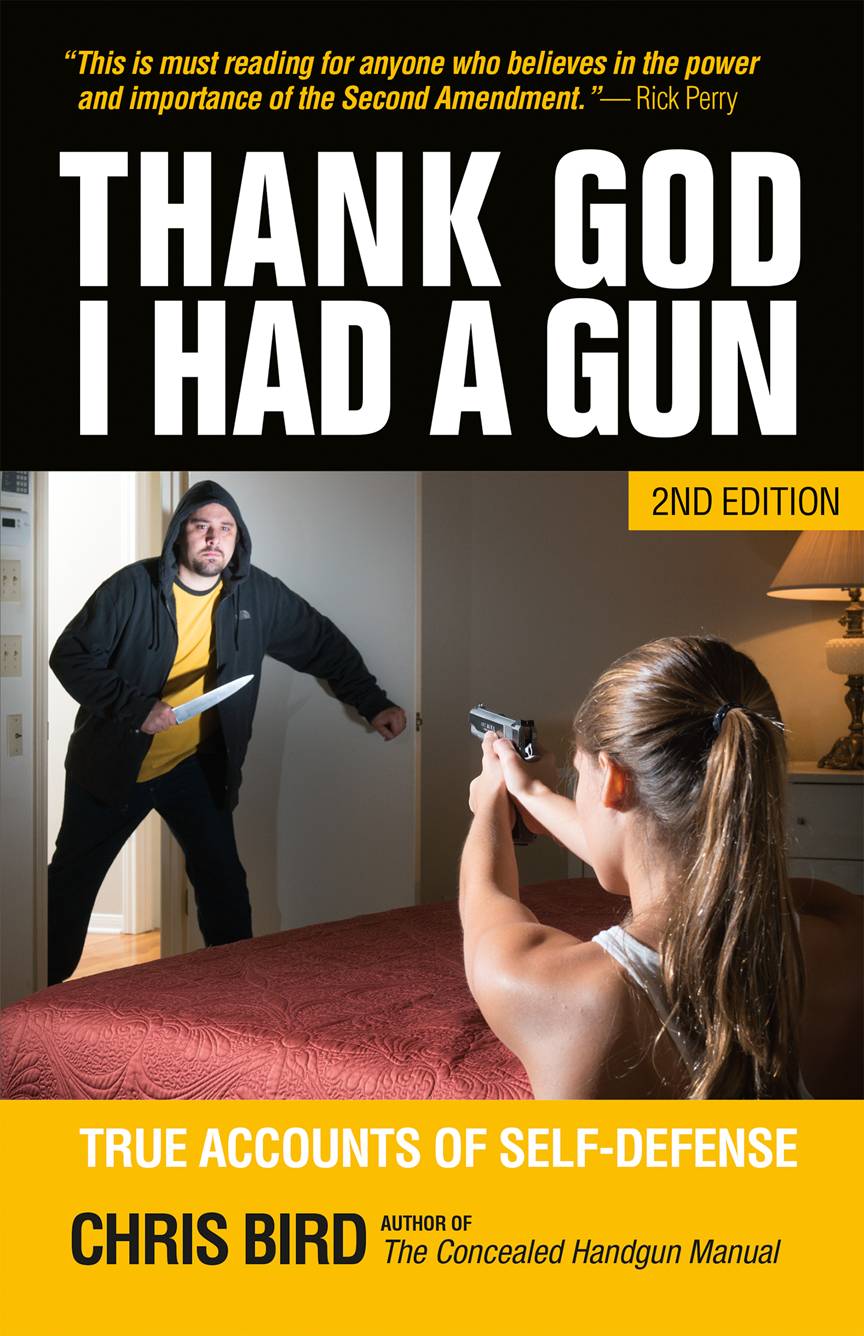
Thank God I Had A Gun: True Accounts of Self-Defense
$19.95
America’s Secret: Effective Self-Defense with a Gun!
One of the best-kept secrets in the United States is how often and how effectively ordinary citizens defend themselves with firearms against criminal attack or criminal threat. A lot of people – politicians, government bureaucrats, academics, journalists, and people who are against guns and self-defense – don’t want you to know this.
This new edition of Thank God I Had a Gun contains four new accounts of ordinary people defending themselves or others with firearms.
Description
America’s Secret: Effective Self-Defense with a Gun!
Second Edition, Revised and Expanded
By Chris Bird with Forewards by Larry Pratt, executive director of Gun Owners of America and mass shooting survivor Suzanna Gratia Hupp
The new edition of Thank God I Had a Gun contains four new accounts of ordinary people defending themselves or others with firearms.
One of the best-kept secrets in the United States is how often and how effectively ordinary citizens defend themselves with firearms against criminal attack or criminal threat. A lot of people – politicians, government bureaucrats, academics, journalists, and people who are against guns and self-defense – don’t want you to know this.
Criminology professor Gary Kleck of Florida State University estimates that each year about 2.5 million ordinary people in the United States use firearms in confrontations with criminals. In the vast majority of cases, not a shot is fired and the incident is frequently not reported to the police. This and the bias of the mainstream media against portraying guns in a positive light, results in these incidents occurring below the public’s radar.
Thank God I Had a Gun: True Accounts of Self-Defense lifts the veil surrounding the defensive uses of guns by recounting in detail seventeen of these incidents. These are some of those stories.
- Vic Stacy went to the assistance of a police officer after a neighbor shot and killed a couple at an RV park in central Texas. Stacy is credited with probably saving the life of the first responding officer and was hailed as a hero. The story was ignored by the national media.
- Melinda Herman and her nine-year-old twins retreated to the attic when a burglar broke into her rural home in Georgia. When the burglar followed them into the attic she shot him repeatedly and escaped with her children.
- Sarah McKinley had just lost her husband to cancer when a burglar broke into her mobile home looking for his prescription pain killers. She shot and killed him while defending her three-month-old son.
- Concealed handgun license holder Rory Vertigan shot and captured a Mexican drug trafficker who had just shot and killed a Phoenix, Arizona, police officer.
- Barbara Thompson, owner of a wholesale plant nursery, killed one burglar and wounded another with a shotgun after a series of burglaries at her Fort Worth business. Eighteen years later her husband Dean did the same thing – one wounded, one dead.
- Ron Honeycutt had been delivering pizzas in Indianapolis for 20 years. When a robber tried to hold him up with a gun, Honeycutt shot his attacker between 10 and 15 times killing him. He was not prosecuted but was fired by Pizza Hut.
- When David Arroyo gunned down his wife and son in the courthouse square in Tyler, Texas, Mark Wilson grabbed his gun and engaged Arroyo in a gun battle in which he was shot and killed. Tyler is celebrating Wilson as a hero who probably saved several lives.
Who are these ordinary citizens who have the courage to fight back against criminals?
The book looks at their lives, recounts both the incident and what happened afterwards, and reflects on lessons learned. The Foreword to the Second Edition was written by Larry Pratt, executive director of Gun Owners of America.
Chris Bird is a shooting instructor who lives in San Antonio, Texas. He is a former police reporter for newspapers in Texas and Canada, a former officer in the British Army’s Royal Military Police, and author of The Concealed Handgun Manual: How to Choose, Carry, and Shoot a Gun in Self Defense, now in its sixth edition.
Thank God I Had a Gun is distributed through Privateer Publications and Independent Publishers Group. The retail price is $19.95.
Title: Thank God I Had a Gun
Subtitle: True Accounts of Self-Defense
Edition: Second
Author: Chris Bird
ISBN: 978-0-09835901-5-6
Pages: 400
Photos: 68
Binding: Paperback, perfect bound, 5½ X 8½
Retail Price: $19.95
Advance Praise for the Second Edition of Thank God I Had a Gun
“Chris Bird has written the book the left-wing media does not want you to read. These stories illustrate that nothing is more effective at stopping dangerous people than well-trained individuals with the firepower to fight back. This is must reading for anyone who believes in the power and importance of the Second Amendment.” – Rick Perry, Former Governor of Texas
Acclaim for the First Edition
“As one who has been debriefing gunfight survivors for more than 35 years, I was particularly pleased to read Chris Bird’s new book, Thank God I Had a Gun: True Accounts of Self-Defense. Chris doesn’t just push a political agenda in the polarized debate on gun control: he shows the human side of these larger-than-life events in which an armed citizen’s wherewithal — in terms of both equipment, and personal courage and preparedness — made a profound difference. From the paralyzing terror that many of the survivors had to overcome before they fought back, to the tragic heroism displayed in the Tyler, Texas incident, to the post-event psychological trauma suffered by the armed citizen in Phoenix who shot it out with a cop-killer, Chris’ book shows the reality of this topic.
“There is much to be learned from Chris’s painstaking, detailed research. I recommend this book highly.” – Massad Ayoob, author of Combat Handgunnery and director of the Massad Ayoob Group
“The public is bombarded daily with articles, news stories, books and conferences by gun control advocates seeking to disarm law-abiding American citizens. In Thank God I Had a Gun, Chris Bird has written a book based on real stories about real people who exercised their God-given, and constitutionally-guaranteed right to defend themselves through the use of a firearm. He employs the truth where those on the other side employ chicanery. Every citizen who believes in freedom owes it to themselves, their family and their friends to read this book.” – Bob Barr, former Georgia Congressman and member of the NRA board of directors
“Mr. Bird’s book is a star in the galaxy of personal protection – a sampling of the importance of freedom to own and lawfully carry firearms. The chapter on New Orleans post Hurricane Katrina, alone, is worth the price of the book.” – Marion P. Hammer, past president of the National Rifle Association and executive director of Unified Sportsmen of Florida
“Excellent text, with character and situation development reminiscent of Joseph Wambaugh! It reads well, and I love the conclusions.” – John Farnam, author of The Farnam Method of Defensive Handgunning and president of Defense Training International
“The second amendment was not drafted for hunting; the Founding Fathers knew the importance of self-defense against criminals and a possible tyrannical government. Chris Bird has made it very clear that if you believe in gun control, you may be only one incident away from committed support of gun possession for self protection!” – Ron Paul, Former Texas Congressman
“The subjects of Chris Bird’s newest book Thank God I Had A Gun: True Accounts of Self-Defenseare very ordinary people. They were not SWAT cops, nor were many of them very heavily trained. In the accounts comprising the book, possession and use of guns changed the course of events for these citizens. The stories should serve as both inspiration and caution for the private citizen considering how to defend self and family from the ever-present threat of crime.” – Gila Hayes, author of Effective Defense and co-owner of Firearms Academy of Seattle
“Great true stories that spark a self analytical, ‘what would I have done?’ The chilling narrative on post Katrina New Orleans should be required reading for those who doubt the Second Amendment’s relevance in today’s America.” – Jerry Patterson, Texas Land Commissioner and former state senator who sponsored the Texas Concealed Handgun Law
“At Tac Pro Shooting Center, we try to break all the myths out there, so students are more prepared for what can happen in a real gunfight—especially with handguns. We want them to understand that they must see the clues and be aware of their surroundings; that the old .45 is not going to “knock them back” or “throw them to the ground;” that shot placement trumps both velocity and caliber; and that staying in the fight is crucial. Chris’s research and investigation in Thank God I Had a Gun, provides real-life examples of these fundamental truths.” – Bill Davison, president of Tac Pro Shooting Center, former Royal Marine and firearms instructor to British Special Forces
“When someone asks smugly, ‘Why does anyone need a gun?’ veteran journalist Chris Bird provides 14 irrefutable answers in his masterful retelling of the deadly, true-life experiences of men and women who survived only because they had a gun when suddenly endangered by murderous predators. This is compelling reading, more convincing than any polemic.” – Joseph P. Tartaro, executive editor of The Gun Mag and president of the Second Amendment Foundation
“Widely traveled, a longtime journalist and retired military officer, Chris Bird is more than amply qualified to write a book like Thank God I Had A Gun.
“He has thoroughly researched his subject matter to inform the reader of over a dozen incidents involving the use of firearms in defensive situations, and one has only to read the first chapter relating to the New Orleans situation in the aftermath of Hurricane Katrina, to realize that this is not another ‘thumb-suck,’ biased gun book.
“If you don’t heed the contents of this book, like ignoring history, you will be condemned to repeat it. Thank God I Had A Gun is a sobering reminder of how society can degenerate in the blink of an eye, protected only by those who are prepared to defend themselves.” – Louis Awerbuck, author of Tactical Reality and president of Yavapai Firearms Academy
“Chris Bird combines his talents as a trainer and a writer. The gripping accounts of those who have used their firearms in self-defense underscores the importance of awareness and training. Don’t just be there. Be alert!” – Larry Pratt, executive director of Gun Owners of America
“Responsible gun ownership is one of the most demanding and important acts an American citizen can pursue. Safe and effective gun handling in the face of vicious criminal assault is the ultimate test of that responsibility. Where can a gun owner go to, to learn the tested skills that save lives? To those citizen-heroes who have already been tested and survived. Chris Bird has collected 14 detailed stories of ordinary men and women who have been forced to face the firestorm. What they did right and wrong, what training worked and what didn’t, what equipment saved some and failed others is uncovered in this exceptional text.
“Brave men and women have already faced down death to learn these lessons. Chris Bird has put their stories together so their courage and sacrifices shall not be wasted. Thank God I Had A Gun is an absolute must read for the responsibly armed man and woman, and needs to be in every serious gun owner’s library.” – Michael de Bethencourt, firearms writer and lead instructor for SnubTraining.com
“Chris Bird tells the compelling stories of good people who used firearms to save lives. When you read these stories, you too will be grateful that these victims were not defenseless when the predators attacked. As Bird shows, taking guns away from good people will lead to good people being murdered. The book shows the personal, life-saving consequences of gun ownership by responsible citizens, and the deadly perils of gun prohibition.” – David B. Kopel, author of Research Director, Independence Institute
“I like it! This is the kind of information the general public needs to be exposed to, to counter the propaganda they get daily. Nice mix of male/female and outcomes.
“Thank God I Had a Gun: True Accounts of Self-Defense is a book long needed. In contrast to the daily propaganda fed to Americans by the mainstream media, here are fourteen accounts of actual honest citizens defending themselves and their families, using guns in the right hands, for the right reasons. With some 12.5 million victims of violent interpersonal crime in the U.S. each year, here are excellent examples of intelligent, proactive people who took back control over their fates.
“Chris does an excellent job of providing background on the characters, detail of the incident, and the aftermath of the crisis. This gives the reader valuable insight into the overall picture of self-defense, rather than just a clinical view of the mechanics involved. I highly recommend this book for gun owners, or those who are considering taking steps to avoid becoming a victim.” – Tom Givens, author of Fighting Smarter, veteran firearms instructor, and owner of RangeMasterin Memphis
“Chris Bird’s accounts of ordinary people using guns to defend themselves – and his comments on the lessons learned – are “must reading” for every serious gun owner. Unlike the unrealistic tough talk of naïve gunshop commandos, the harsh consequences of real-life deadly force confrontations are sobering and highly instructive. If you want a riveting look at truth, not fantasy, this book is for you.” – Emanuel Kapelsohn, vice president of the International Association of Law Enforcement Firearms Instructors, a charter member of the American Society of Law Enforcement Trainers, lawyer, and expert witness in the use of force
Additional information
| Weight | 1 lbs |
|---|
Reviews
There are no reviews yet.