The Texas License
To Carry Course
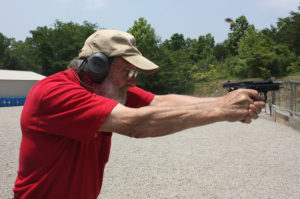
Texas requires applicants for a License To Carry to pass a training course taught by a state certified instructor before the license is issued. The classroom part of the course takes between four and six hours and covers the following:
- Laws that relate to weapons
- The use of deadly force
- Handgun use and safety
- Situational awareness and non-violent dispute resolution
- Proper storage practices for handguns with an emphasis on storage that eliminates the possibility of accidental injury to a child
- Information about open carry including types of holsters
The instruction is followed by a written test containing 25 multiple choice and true-or-false questions. Also required is a 50-round shooting test with a semi-automatic or revolver. The written test and range test are not included in the four- to six-hour time limit.
Cost for the course is $100.
Course Location & Requirements
For the convenience of applicants, Chris Bird usually teaches the course over a period of about eight hours on a single day.
Courses are held on an as needed basis so please call Privateer Publications at (210) 308-8191 or email us to arrange for a course.
Classes are normally held at Chris Bird’s home in Castle Hills or elsewhere by arrangement. The shooting is done at Bexar Community Shooting Range, 15391 Bexar Bowling Road, Marion, TX 78124 or Bracken Recreational Range, 19140 Marbach Lane, Bracken, TX 78266.
On successful completion of the course, the student receives a CHL-100 form to accompany his or her application. All you need to bring is a handgun (semi-automatic or revolver), 50 rounds of ammunition, eye and ear protection, a hat, a notebook, and a pen or pencil.
Application Process
You can start your application process and pay the application fee on line but you don’t have to. If you choose not to apply online, we can provide you with all the documents you need. To apply online, go to the Texas Department of Public Safety web site, Click on Online Services – Concealed Handgun License Bureau.
Application Requirements
Applicants must meet the following qualifications: 21 years of age or older (18 for active military or veterans); pass a criminal record check – not convicted of, or currently charged with, a felony or with a Class A or B misdemeanor in last five years; not a fugitive from justice; not chemically dependent or of unsound mind – capable of exercising sound judgment with respect to the proper use and storage of a handgun; not delinquent in paying child support or taxes; not currently under a spousal protective or restraining order; qualified under state and federal law to buy a handgun; pass the required training course.
License Costs
The Texas License to Carry is administered by the Texas Department of Public Safety. The license costs $40 and is valid for between four and five years. It expires on your birthday.
The license is $40 for senior citizens 60 years and older, and indigents.
Renewal license costs $40 and is valid for five years ($35 for seniors).
As of 2013 there is no longer a requirement to take a training course to renew your license.
Concealed or Open Carry?
In 2015, the Texas Legislature passed several laws that affect Texas residents and their ability to carry handguns for protection. Law makers passed an Open Carry statute that for the first time in more than a century allows Texans to carry handguns openly. This has resulted in changing the name of the license from Concealed Handgun License (CHL) to License To Carry (LTC). Legislators also passed a law allowing anyone with a License To Carry to carry a handgun on the property of public colleges and universities with some areas posted where guns are not allowed. However, on college or university property, the handgun must be concealed. The law went into effect August 1, 2016 for universities and a year later for two-year colleges.
Where Can You Carry?
Even with a License To Carry, license holders may not carry in certain places. These include the premises or buses of schools; polling places when in operation; courtrooms or court offices; racetracks; secured areas of airports; correctional facilities; within one thousand feet of a place of execution on execution day; businesses that derive 51 percent or more of their revenue from the sale of alcohol for on-premises consumption; at high-school, collegiate or professional sporting events. Provided they are properly signed, hospitals, nursing homes, amusement parks, churches or places of worship, meetings of governmental entities, and private businesses. Premises do not include parking areas or driveways. It is illegal to carry while intoxicated.
Reciprocal Agreements with other States
Texas has reciprocal agreements to honor concealed handgun licenses with
Alaska, Arizona, Arkansas, Colorado, Delaware,
Florida, Georgia, Idaho, Kentucky, Louisiana,
Michigan, Mississippi, Montana, New Mexico,
North Carolina, Ohio, Oklahoma, Pennsylvania,
South Carolina, Tennessee, Utah, Virginia,
West Virginia, and Wyoming.
Several other states will recognize a Texas Right To Carry license although there is no formal agreement. Check the state concerned. Visitors do not need licenses to carry concealed or openly in Vermont. Some of these states allow open carry, others do not. When carrying in another state under your Texas license, you are required to obey the laws of the state you are in at the time.
Legislative History
The Texas Concealed Handgun Law passed the Legislature and was signed by Governor George W. Bush in 1995. It took effect January 1, 1996 and is administered by the Texas Department of Public Safety. The license costs $140 and is valid for between four and five years. It expires on your birthday ($70 for senior citizens 60 years and older, and indigents). Renewal license costs $70 and is valid for five years ($35 for seniors). As of 2013 there is no longer a requirement to take a training course to renew your license.
The 2013 Legislature substantially simplified the then Concealed Handgun License (CHL) course to make it shorter. It is now four to six hours of classroom instruction plus range time and time to take a 25-question test. This is a reduction from 10 to 15 hours including the range time and time to take a 50-question test.
Sign Me Up!
OTHER TRAINING
Chris Bird is an NRA Training Instructor and is certified to teach the following courses.
- Home Firearm Safety
- Personal Protection in the Home
- Bird will also give personal instruction in defense with a handgun or shotgun to individuals or groups by arrangement.
Pay Now!
If you have signed up and would like to pay the $100.00 course fee online, click the buy now button below.
Pay Now!
If you owe a different amount other than the $100.00 course fee, please enter it here and pay.